Wuthering Heights (Emily Brontë vs. Emerald Fennell)

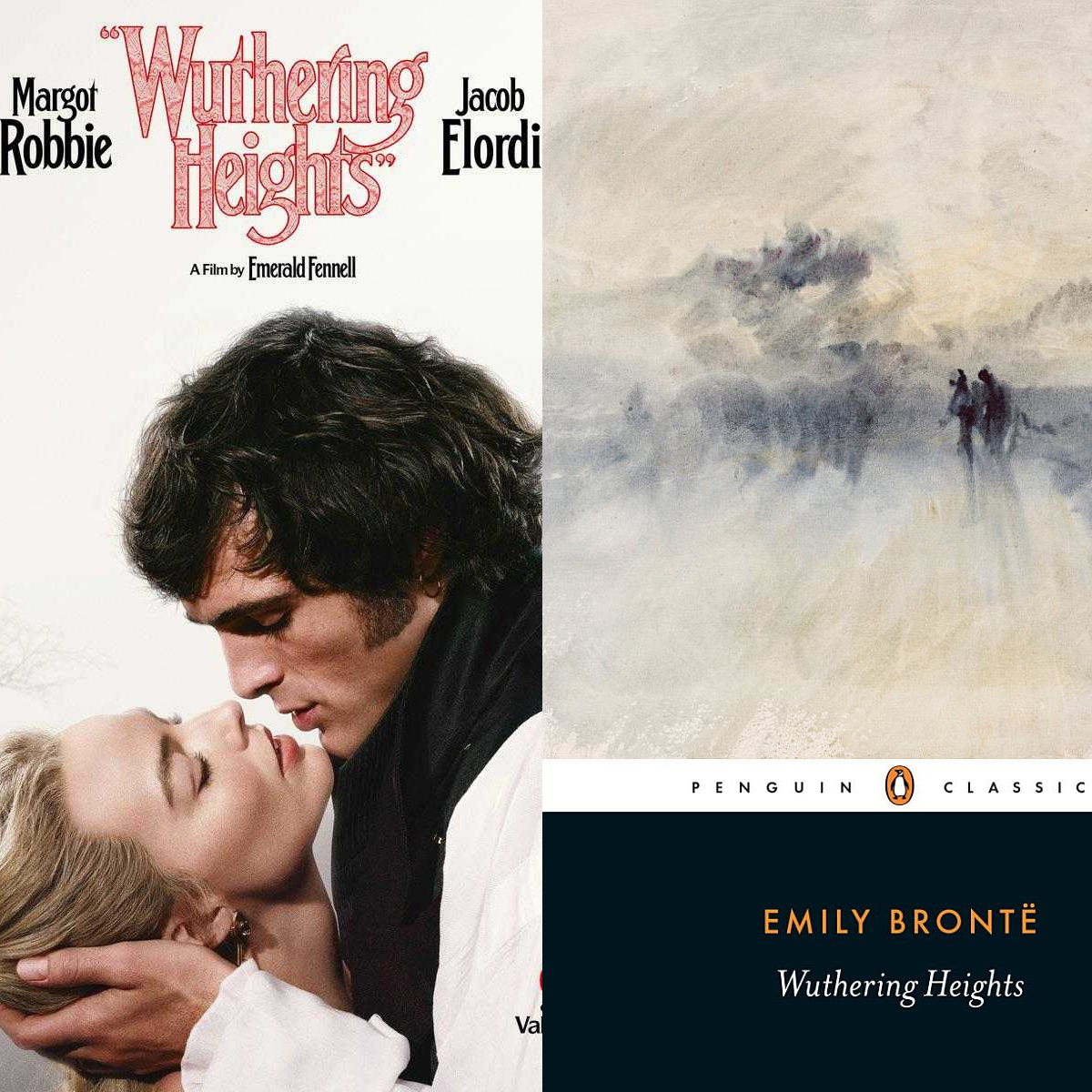
On the surface, the draw of Wuthering Heights may be its timeless romance. But what makes this romance so powerful, and what drives the more significant portions of the book, is unfettered, uncontrolled, unleashed youth. The novel is full of young people making stupid decisions and reaping the consequences, either from God or from each other. Played against an angsty, brooding setting perfect for a teen Anglophile, the novel’s free run of the emotionality of youth proves to be both relatable and eminently fetishizable.
Most of the characters of Wuthering Heights are teens through their portions of the story. Struggling through the peaks and valleys of their pubertal hormones, and with nothing better to do in their minimal environment, they seek out each others’ company to spark and clash and burn together.
Edgar Linton is the oldest to be married, at 21. Everyone else is less than twenty when they enter wedlock: Catherine Earnshaw is seventeen, Heathcliff nineteen, Isabella eighteen, Catherine Linton seventeen, and Linton Heathcliff a tender young sixteen. And although Heathcliff ages twenty years through the second half of the story, his emotional growth as an adult isn’t just stunted; it’s altogether decapitated. He is profoundly and irrevocably imprinted with the feelings that continue to define him throughout his life in his early teens, and carries both his torches and grudges to his death, never developing past the emotions of his youth.
To this cast of young folk, first love is forever, and even death may not do them part. But Brontë does not let us forget that the other face of love is hatred. While romance dominates the first half of the book, it is rage, grief, melancholy, and contempt that drive the second. Wuthering Heights has a reputation as a Gothic romance novel, but past the first fifteen chapters of its 34 total, there is very little romance and a shocking amount of physical, emotional, and various forms of domestic abuse. Like Pandora’s box, hope manages to flower at the end, but only after Heathcliff, having become an avatar of cruelty, finally dies.
To wit, it absolutely confounds me that readers glorify Heathcliff and Cathy’s relationship, or even mistake it to be the point of the novel. You could say that Cathy and Heathcliff find in each other the love of their lives, and when they lose it, life becomes worthless, and the world and its innocents should suffer for depriving them of something so precious. But this only makes sense from the narrow and exaggerated perspective of youth.
From an adult perspective, this is idiotic. It’s a fantasy, if a romantic one, that true love can only happen once in life with the first person you encounter. And it’s a fantasy, if a dark and twisted one, that you can just punish everyone around you–including your children, nieces, and nephews!–because you lost love, no matter how fated.
Instead, I believe that the (rather drier) point of the novel is to explore the boundaries of Society, a crucially important governor of life in Victorian England. Heathcliff was born outside of society (as a “dark-skinned gipsy”), lives in a rural setting where society is thinly applied, and upon losing Cathy, defies society–in fact, by ripping up and burning the social contract. He abuses his local power, his legal knowledge and wealth, and his relationship with Mr. Green, the local enforcer of society, to transport Wuthering Heights outside of the warmth and safety of social bounds. He becomes a monster who fears and faces no consequences when using antisocial methods like violence and kidnapping to enact his will.
Who wronged Heathcliff and drove him to become such a fiend? Society itself, of course. As Cathy’s suitor, he had no prospects: no last name, no education, no family, no wealth or lands or titles. He was at the rock bottom of a strict class-driven hierarchy, and so he was, by society’s rules, never to be a match with what he perceived to be his true love. So it is only right that he first does become a suitable match. Even a birthright-based class system provides alternative paths to higher status, such as rising up through the military; Heathcliff seems to have taken such a path and become a respectable society-man in just a few years. But he is too late to claim Cathy’s hand in marriage, and filled with spite and anger, he refuses to continue working within the system and instead directs his energies to blowing it up.
“Society” is too nebulous to attack directly, so instead, Heathcliff chooses to enact revenge on those who profited off their positions in society to his detriment. Primarily, of course, is Edgar Linton, who stole Cathy Earnshaw away twice over (as Heathcliff believes Edgar is responsible for her death). Heathcliff plans to destroy him by attacking Linton’s representation of value within society: his wealth, holdings, and inheritors. And, generally out of view of the story’s narration, Heathcliff quickly and ably destroys Hindley Earnshaw, who bullied Heathcliff as a child and is also an heir to the Earnshaw name, something Heathcliff covets but can never receive.
All this nuance and analysis appears to fly right over the heads of readers focused on the Cathy-Heathcliff romance, a group that now includes the accomplished film director Emerald Fennell. Her 2026 release, sharing the title Wuthering Heights, cannot charitably be called an adaptation. It is flashy, fleshy, edgy, rich in visual texture and color, and completely divorced from any meaningful representation of the novel.
The most obvious sign is that Fennell simply cuts off the latter nineteen chapters’ worth of content. The feature-length film is entirely focused on the living relationship between Catherine Earnshaw and Heathcliff, cutting out the family drama and revenge plots. In losing all this, there isn’t very much story to tell. Readers might recall that the book is actually quite boring when it comes to describing the everyday routines and physical togetherness of Cathy and Heathcliff. Most of its romance is concentrated in how they speak about their relationship and feelings, and notably, there’s not even a suggestion of sex–all the power is in the yearning. As a result, the film pads its runtime with garish new scenes and content designed to titillate the senses and grope at the viewer’s base instincts.
Adding to the unwatchability of the film is the casting. Margot Robbie, 35, and Jacob Elordi, 28, are ridiculous in their roles, which have not been rewritten for emotional maturity. (For reference, Cathy and Heathcliff are respectively eighteen and nineteen at the point in the story where the film concludes.) Readers can suspend disbelief and indulge vicariously in the raw, uninhibited, mercurial feelings and actions of the novel’s characters because those characters ARE immature and naive. Robbie and Elordi performing immaturity and naivete becomes less an allegory for the wildness of youth and more for the bleakness of Hollywood’s endless pursuit thereof.
Another point Fennell has missed is that Heathcliff is the center of Brontë’s novel, not Catherine. He is defined by his existence on the outside, and is transformed and twisted by his jealous desires for acceptance and revenge. He causes unimaginable suffering to others and could never be considered a hero. But to Fennell and other readers who have not deigned to finish the novel, Heathcliff is simply tall, dark, and handsome, a brooding receptacle for transgressive erotic fantasies. They misinterpret his intensity, boundary-crossing, and self-destruction for kinkiness and sensuality, ignoring or fetishizing how he inflicts pain on everyone but the object of his love.
The novel is a literary classic because it does not shy away from the great destruction that comes equal to great passion. But Fennell’s film chooses to be insipid and ignorant, and believes that substituting sex scenes for consequences is somehow a worthy exchange. Sure, it’s provocative, but it asks no questions and challenges nothing. What’s the point of borrowing from the aesthetic of the novel without touching any of the substance?
Book
Plot: 3 / 5
Themes: 3 / 5
Prose: 4 / 5
Movie
Plot: 1 / 5
Themes: 1 / 5
Visuals: 3 / 5