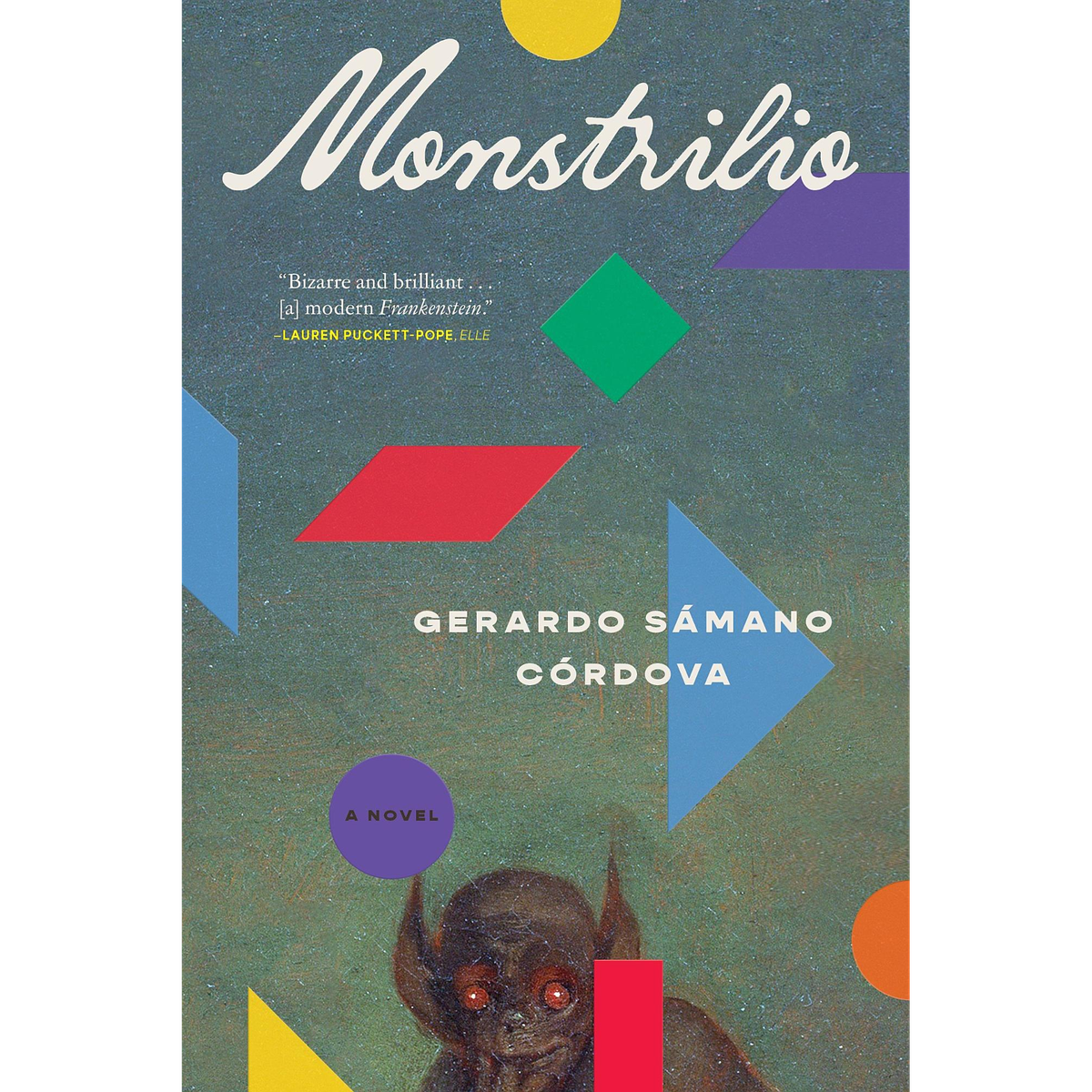
Monstrilio: A Novel, by Gerardo Sámano Córdova
Monstrilio introduces itself as a horror novel, but that’s like calling Titanic a musical. Sure, the string quartet’s rendition of Nearer My God to Thee is a climactic scene, and so is M eating people, but that’s hardly the point of either thing. In both cases, these dramatic flourishes are used to highlight themes common to the two works: love’s ability to cross boundaries, the facade of civilization, and the hubris of mankind. And besides, one could even argue that Monstrilio is less a horror novel than a study in astronomy, a chronicle of the satellites that orbited a child named Santiago before he died.
The chapters are each named after and narrated by a different satellite. We start with Magos, Santiago’s mother, and move on to Lena, Magos’s best friend, before reaching Joseph, Santiago’s father, and finishing–quite Mysteriously–with “M”. The book progresses linearly without doubling back, and so our understanding of the narrative as a whole is fractured into four different perspectives: a reminder that life, and also death, rejects the possibility of being wholly known; is, despite our best efforts at mapping its nodes, nondeterministic.
Meditations on grief are often somber. They can also be angry, raging at the cruelty of a life ended too soon; nostalgic, in remembrance of the time that was allowed; or simply confused, containing too many emotions tangled together to isolate and inspect any given one. Monstrilio is at times angry, nostalgic, and confused. But it never resorts to stewing in sadness or despair. Córdova avoids weighing down his words with sappy, trite somberness, instead preferring to have his characters act it out like a stage direction. He only allows their performances, rather than the unproxied emotion, to be evaluated.
Other feelings are given space to captivate, like joy, wonder, and simply primal satisfaction. Magos takes a while before she can cry for her loss, but once she does, she is fêted for her triumph. Joseph finds a new companion who provides the bubbliness and adoration characteristic of a “golden retriever boyfriend”. Lena gains a unique new specimen for her scientific curiosity. And there is M, of course, who is raw, unfiltered, an empty void who only asks to be filled with knowledge, love, and–yup–meat.
My colleague points out that each character is biblically named: Magos for the three magi; Joseph, Luke, Peter, and Thomas for their namesake figures; and Lena for Mary Magdalene. Following this thread, the four named chapters of Monstrilio are as books of Gospel. The Trinity is a layup: Santiago, the Father; M, the Son; and their shared soul, the Ghost.
Of course, it’s not that easy to rebuild God from scratch–especially with pagan folk magic. Córdova sets up the transmutative ascension of his trinity, but things take a dark turn when Magos, the unwitting catalyst, rejects the ritual purification of the Mass her mother insists on performing. Tainted by her roiling, unresolved emotions, Magos is unable to capture Santiago’s soul into the new body she grows from his lung. Instead, what she embodies is her own grief: a force so strong that it has taken on a life of its own. M, the product of this alchemy, is no benevolent Jesus-figure. He is an antichrist.
Baby Monstrilio is as hungry and destructive as any young demon. He cannot be meaningfully tamed by the interventions of man (or woman). Even though he learns to be human under the watchful eyes of Santiago’s apostles, M’s person-skin remains a thin veneer over the monster underneath, bulging and bursting at the seams.
Pitifully, the “adult” M is tortured by the darkness residing in his depths. His existence threatens everyone around him, including the people he loves. Does he even truly love them? Echoed memories confuse him further; it is unclear which of his emotions are shadows of Santiago’s and which are ones M has developed himself, and M resorts to experimenting with new relationships to get closer to the truth.
Not by his own conscious intention, these experiments culminate in a satanic ritual that only serves to feed the darkness inside. (When do they not?) As M’s emboldened base nature lashes out in more and more violent ways, his wardens are faced with increasing pressure to resolve this Jekyll-and-Hyde situation. Despite his carnivorous tendencies, M has grown into a unique, interesting, and loveable individual–a precious new son to his family. The steps that they would need to take to stop his rampages do not bear imagining.
Córdova slyly reveals that the answer was never to actively contain (or worse, terminate) M. The release of tension starts before we even notice it, and whether in a discrete epiphany or an understanding over time, each character comes to the same realization: M was never truly of the human world, and embodying him in Santiago’s flesh only made him linger and cause hurt. They love him, and finally, let him go.
Plot: 4.5 / 5
Themes: 4.5 / 5
Prose: 4.5 / 5