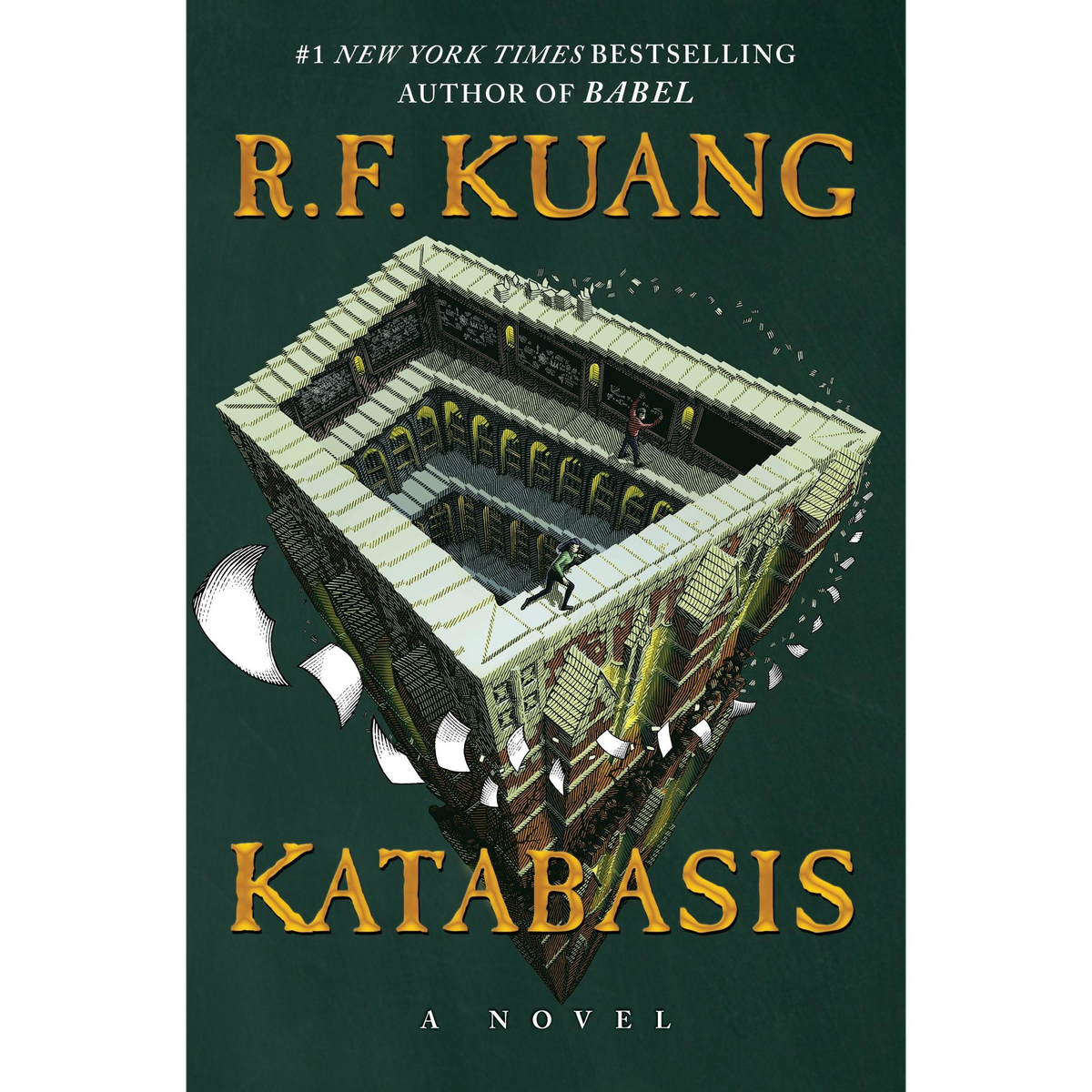
Katabasis: A Novel, by R. F. Kuang
It’s been done before.
That’s the starting point for Alice and Peter, two grad students who have made it their mission to go to Hell. There is nothing new under the sun in their world of analytic magick, and so they, like any other students of mathematics, literature, and philosophy, build on foundations laid by ancient thinkers. In this case, their research starts with Ramanujan’s Summation with Setiya’s Modifications: a straightforward portal to the underworld. Alice and Peter stand on the shoulders of giants, and intend to jump down as far as the universe goes.
What follows is a tragic and thrilling journey as Kuang puts her protagonists through Hell, forcing them to fight for every step they take through the dark realm. Katabasis is a story of struggle, and the wins that Alice and Peter accrue are few and far between. Much more often, they lose: lost battles, lost comrades, lost ways, lost hopes. Disguises and distractions are pared away, too; with each successive level of Hell revealed to us, Kuang rakes up another agonizing truth that is all the more powerful for how hard her characters have worked to conceal it.
In the same kind of self-referential trick that Kuang’s magicians employ to twist reality, Katabasis is recursive and fractal. Titled like a monograph, it actually is one: a deeply researched review of the classic trope of journeys to hell in real literature, both ancient and modern. Though it uses a fiction narrative to flesh out its academic bones, the characters within Katabasis pull ideas and references from this real research in order to embark on their own iteration of the mytheme. Personal struggles throughout this narrative are chronic and spiraling; Crohn’s disease is employed as an example of how just existing in one’s body can be an enduring hell. And of course, Kuang makes no pretense with her attitude towards graduate school, casting the experience as a hellish odyssey full of above-it-all advisors, ravenous competitors, and innumerable indignities. Each of the many threads woven into the novel’s thematic tapestry is either a reflection on or an instance of katabasis, a masterful juggling act that constantly reinforces the richness of the text.
In this way, Kuang acknowledges the banality of it all: it’s been done before. The metaphor is tired, and she’s hardly the first to write about it. But what does make Katabasis refreshing and innovative is Kuang’s interhemispheric approach to her citations. She makes a significant effort to balance the usual suspects of Greek and Roman classics with Buddhist scripture, pointing out that Eastern schools of thought have always had just as rich a philosophy of death and the underworld as the West. When Alice finally reaches the king of Hell, he offers to transform into any incarnation of that global deity that she feels most comfortable with. Alice picks Yama, the pan-Asian inhabitant of that role, and Yama proceeds to talk with Alice in Chinese, her childhood language. Like with all of Kuang’s work, the lens of Katabasis is one of Asian American identity and the struggle for honest, meaningful representation of its myriad facets.
Though it is remarkable in its scholarship, Katabasis is also tuned perfectly to the modern publishing world. Kuang’s voice is pitch-perfect for the millennial-Gen Z crossover audience. She tosses out impenetrable blue curtains in favor of blunt analogies, fast-paced action, and a pop-romance friends-to-enemies-to-lovers arc: refuges for readers whose eyes glaze over at the homework of parsing philosophic principles. Kuang sets her story in Cambridge because it’s one of her almae matres, but make no mistake–it’s also the perfect “dark academia” setting to brew up a new entry to the best-selling genre of Magic School Drama. Such a place would not be complete without an animal mascot, who is tritely a namesake of T. H. White’s magical owl, Archimedes. If it wasn’t clear that Kuang was writing from her lived experience, it would all add up to too much–or rather, not enough: a tower of tropes and BookTok hashtags threatening to collapse into insubstantiality. There is self-awareness here, as in how Kuang allows the facade of Hell-as-campus to fade after just two levels, but the narrative is otherwise dogged by a sense of predictability. For better or worse, much of it has been done before.
In a more novel twist, Alice and Peter’s analytic magick is based on the power of contradiction. They use paradoxes and thought experiments to hold antipodal beliefs in their minds, which then translate to reality in a “mind over matter” situation where the laws of physics are fooled for as long as the contradiction is not disproven. Modern fantasy has accepted as axiomatic that spells are a mechanism of speaking belief into existence, and Kuang fluidly interprets this as “the act of telling lies about the world.” What is particularly powerful about this magic is that Alice Law performs it on herself, constantly. As she slogs year by year through the crucible of her graduate program, and then as she fights through the endless gauntlet of Hell, every part of her identity and every ounce of her strength is eroded. Kuang creates a character who can only remain sane and competent by continually lying to herself that she is so, in contradiction to every examination of her body, mind, and soul. Is this not a reminder that we, too, are magicians in our real lives? We, too, endure our own katabases, and there are times where we, too, have no strength to go on. In those times, what else is there to do but believe in the contradiction?
Plot: 3 / 5
Themes: 4.5 / 5
Prose: 4 / 5