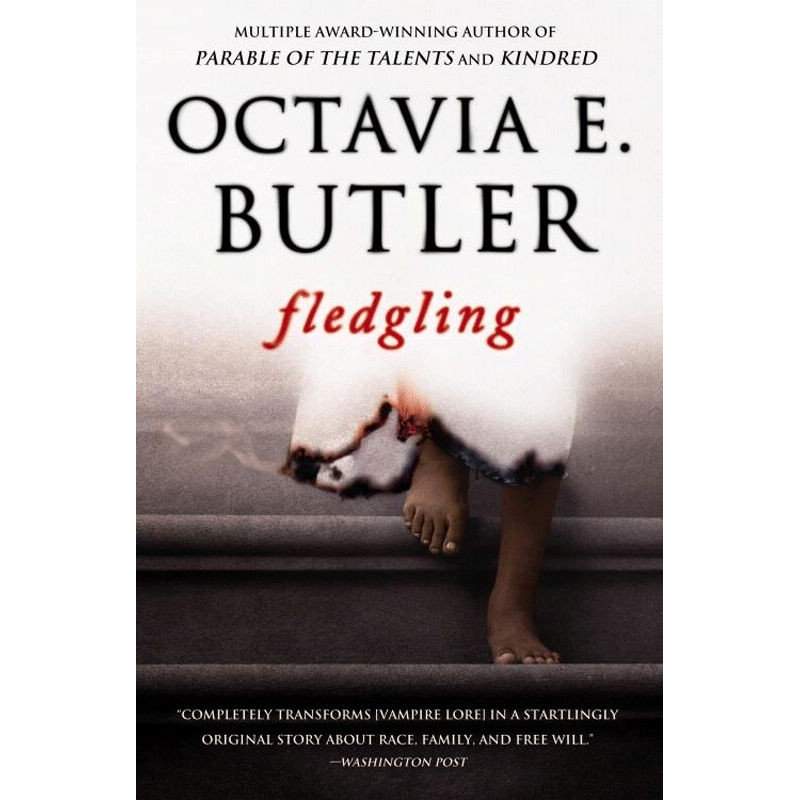
Fledgling, by Octavia E. Butler
Octavia Butler is most famous for her Parable of the Sower, published in 1993 and featuring prescient themes about social and climate justice that remain relevant more than three decades later. Butler was a productive author and worked on many books, stories, and essays before and after Sower, many of them challenging the established social order in similar ways. Black women were her favorite protagonists, and her narratives explored ways where they could transcend the human body and create new, more evolved communities. Fledgling was her last published book, just a year before her death and twelve years after Sower, and follows in the same tracks as her previous work, breaking little new ground.
Fledgling is the story of Shori, an Ina girl. The Ina are a vampire species that has evolved alongside humans in Shori’s version of Earth. Upon entering the story, we find her grievously wounded; she has been the victim of some kind of attack. She shelters in a little cave in the woods, where she sleeps, hunts large animals, and recovers her physical strength–but not her memory. Shori is completely amnesic and remembers nothing about herself or the attack. At first, she operates entirely by instinct. Small fragments of object recognition return as she heals, but not any recollection of who–or what–she is.
Seeking answers, Shori begins exploring, and encounters a human for the first time in her short memory. Driven by overwhelming instinct, she bites him. The addictive venom in her bite causes him to become compliant and suggestible, and she turns him into her primary lackey, or “symbiont”. The man (named Wright) acts as her replenishable food source, providing blood for Shori to lap up like a cat from an arterial fountain. In return, her venom grants him orgasmic pleasure as well as an extended lifespan. Later, we learn the catch: withdrawal is deadly, so Wright can never leave Shori.
Not that he would want to. Wright considers the upsides of being 23 years old forever, not to mention the bonus of a robust sexual relationship with Shori. (Despite her presenting as a “ten or eleven-year old” girl, they are both delighted to turn most of Shori’s feeding sessions into sex.) Also, he loves her! Well, it’s unclear if he loves her and that is why he wants to accompany her as a symbiont, or if he is misinterpreting the rush of pleasure and power that he associates with being her symbiont as love, or–worst of all–if he is convinced he loves her because she is drugging him with an addictive hypnotic and conditioning him with sex. All of the above? Butler blithely skips over this field of thorns, but we’ll get into it in a little bit.
There are more attacks, and as Shori and Wright fend off waves of killer goons sent by an unknown adversary, they manage to find and contact an Ina clan that she was close to in her previous life: the Gordons. They are shocked that Shori is alive, and tell her that her whole family was massacred and she was presumed dead. But now that she has revealed herself, the Gordons offer her refuge, and more importantly, information. What is it to be Ina? What is their identity and culture? How does their symbiosis with humans work? Who is the attacker, and why are they so desperate to cut off her bloodline?
The first half of the novel is a quickly paced thriller that thrums with the energy of Butler’s short, to-the-point sentences. The second half is a puzzle adventure–the next installation of Professor Layton vs. Phoenix Wright: Ace Attorney. It’s like playing an open-world RPG, getting through a few combat-heavy dungeons, and then finding out that the rest of the game consists of wandering around a library and reading the right lore books to activate cutscenes. Is that latter type of experience bad? Not necessarily, but it sure is a tone shift.
In this second half of the book, the Gordons find evidence that it is another old and respected Ina clan, the Silks, that are trying to kill Shori. The reason? Shori, the product of genetic engineering, also has Black human blood, giving her exceptional strength, intelligence, and the ability to move in the daytime. (The Ina species is pale-skinned and cannot abide sunlight.) To the Silks, she is an abomination that must be purged.
We can acknowledge the overt allegories of white supremacy and anti-miscegenation. More interesting is the way that Butler is attacking these ideas: not with equality, or even a straightforward, non-comparative right to life in itself, but with superiority. Shori’s dual identity is far more than the sum of her parts. Compared to pureblooded, pale Ina, her venom is more powerful, her smell more enticing, and her moral compass more true. Perhaps in overcompensating for the dearth of Black and especially Black women vampires in the canon, Butler has built Shori into a prototypical Mary Sue. (Interestingly, Shori’s most apparent kinsman, Blade, is also of mixed heritage and can walk in the sun.)
Speaking of vampires in sun, much like Renesmee of Twilight (like Shori and Blade, also a half-blood dhampir!), Shori learns that her grievances must be adjudicated by a jury of her peers. When it comes time for the Ina council to make their final judgment on Shori v. Silk, our intrepid protagonist, by some revelation, finds the one true argument that perfectly dispenses justice to everyone. This argument is one that only the most ancient and well-read Ina would be familiar with; even before her memory loss, it is extremely unlikely that young Shori would have heard of it. And yet, at the eleventh hour, she is able to divine it from first principles. Truly, she is wiser than her years!
Let’s not forget about her sexual maturity as well. This is not the first time that Butler has introduced a weird age dynamic with her protagonist. Those familiar with the Parable of the Sower may recall that the eighteen-year-old main character, Lauren, enters into a relationship with the older Dr. Bankole, 57. That age gap is certainly remarkable, but not directly comparable to that of Shori and Wright (53 and 23, respectively). What’s more off-putting is that Shori appears to be a preteen girl, a trope that anime fans may be familiar with as “sexy loli girl-child who is actually a thousand-year-old dragon in human form”. Furthermore, no characters balk at the idea of sex with the childlike Shori. In fact, she is the object of desire for quite a few men and women! At most, someone will comment on concerns of legality or how her and Wright’s relationship might “appear”, but there is no sense of disapproval. There is only a feeling that the normal humans who are out of the loop don’t understand, and if they did understand, they would bless Shori and Wright’s union.
For argument’s sake, let’s say that Shori is a consenting adult. The next question: are the symbionts? Butler teases the idea of choice and free will like a laser dot for cats to chase. She informs us that there is a window of venom addiction where it is not yet permanent and the human can voluntarily leave the symbiotic relationship. Shori directly confronts Wright at the end of his window and asks him if he would like to stay. Later, she poses the same question to other would-be symbionts, Theodora and Joel. In all three situations, the human is presumably supposed to agonize over each pro and con before coming to a well-reasoned decision and either offering or rescinding their consent. This is, of course, a ridiculous premise.
No human whom Shori has “grazed” can offer meaningful consent. She has already violated their bodies and boundaries with her first bite, which she (and every other Ina), in every case, applies inarguably and entirely nonconsensually. And through this transgression she has compelled them to fall and remain under the influence of an addictive, hypnotic drug; has compelled them to even consider symbiosis at all. Any decision they make following that first bite and under this undue influence cannot possibly be considered anything but coercion.
For people like Joel, who grew up in Ina culture, his parent was also victimized in this way and had meaningful decision-making removed from them. Thus Joel was nonconsensually raised around Ina, which in turn created a familial and environmental pressure that affects his decision to become a symbiont himself. Law students may be familiar with an analogous concept that invalidates evidence produced from a tainted source: fruit of the poisonous tree.
It’s not that Fledgling is badly written or purposefully problematic. It is a product of its time, and is itself written as a challenge to those times. In that context, it’s an interesting world-building exercise that makes timely commentary on eugenics, racial superiority, and female-dominant power dynamics. And on top of that, it’s a fun read! But it’s clear that Butler was continuing to excavate rocky ground with a rusty shovel even towards the end of her career. Retrospectively, Fledgling is part of an insightful, hopeful, and revolutionary body of work. Through a modern lens, it’s a tough sell–a testament to how much has changed for the better.
Plot: 2 / 5
Themes: 2 / 5
Prose: 4 / 5