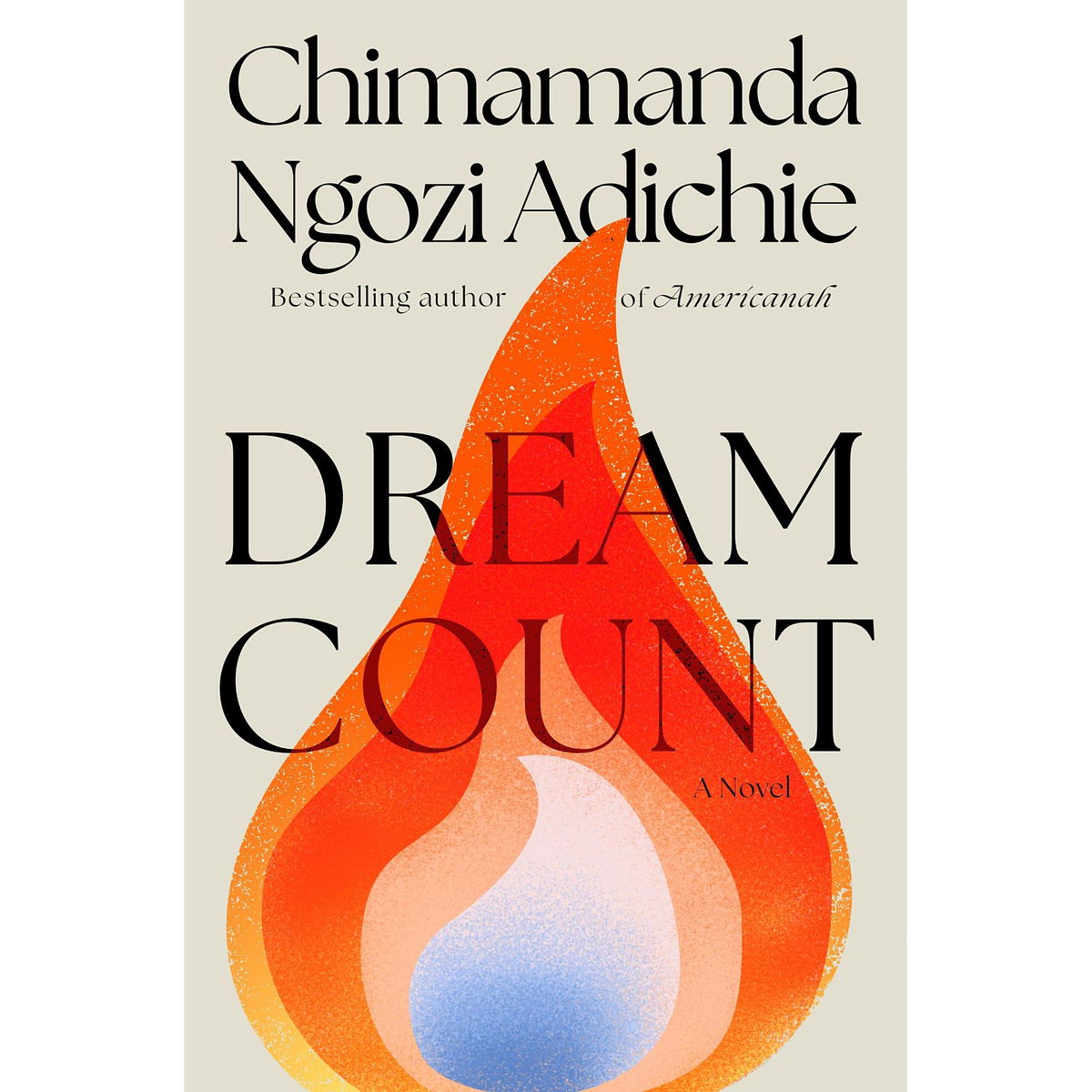
Dream Count, by Chimamanda Ngozi Adichie

It’s hard for me to engage with COVID-19 pandemic media. When characters pick up masks and testing swabs or start stocking their pantries for quarantine, I try to follow their stories–and ram headfirst into a translucent wall of foot-thick epoxy in my mind. I watch the pandemic unfold from behind this wall, and everything I see is foggy and distorted. It feels theatrical, inconsequential, silly. It feels distant.
I turn around to see my own memories of this time, and the wall is behind me, too. I know that I lived through it, but I have a hard time looking back. Some of us have processed our experience of the pandemic better than others. Clearly, I haven’t processed much of it at all.
Perhaps that’s why I liked Dream Count. It’s unquestionably a COVID-19 novel, but nobody gets sick. Nobody dies in an overflowing hospital with not enough doctors, not enough supplies, and no cure in sight. Dream Count sets its stories in the society of the pandemic, but without its actual appearance in the novel, this setting is entirely pretextual. The masks and quarantines are just as I see them from behind my mental wall: theatrics.
That does not mean Dream Count is frivolous or devoid of insight. The theater of the pandemic is just window dressing for an exploration of the rich lives of four women. What better setting to do this than quarantine? Bored and alone in lockdown, we all spent time in reverie, flicking idly through an neverending dream-album of memories.
Even more relatably, Chiamaka’s favorite floats in the parade down memory lane are manned by men. The internal desire to not be alone is especially strong in quarantine, but Chia bears the weight of constant external pressure also. She hears a nonstop refrain from her family and culture that is part of a globally recognized chant: When are you going to find a man? When are you going to settle down and start a family? When will you give us sons, daughters, grandchildren?
It’s not just Chia, of course. Each of the stories of the four women of Dream Count are framed with respect to the men they intersect with. Chia has the longest list of lovers, but we also watch as Zikora braves the dating scene in America–only to be betrayed by the father of her child. We watch as Omelogor engages with the idea of men through her blog For Men Only and her Short Passion Attacks, and as she defines her career in opposition to men. We watch as Kadiatou struggles with the curse of her first husband, then as she is led to America by the leash of Amadou’s promises, and then as her life is destroyed by a male rapist.
The symbolism is clear: even though the book is about women, their stories must yet be centered on men. Kadiatou is the most tragic example. In America, she finally makes a life for herself that is full of potential (and women). She has her exceptional daughter, her supportive women coworkers, her friend network with Chia, Omelogor, and Zikora. But a man repulsively forces himself on her–even more tragically, it’s not the first time–and her life becomes entirely about that act. Ladies and gentlemen, the patriarchy hard at work.
The beautiful escape hatch that Adichie grants her Dream Count protagonists is the realization that every one of them is unmarried by the book’s end. Despite everything, they persevere as independent women that support other independent women. Even crushed under the pressures of gender roles and societal expectations, life will find a way to wriggle out and thrive. Having freed themselves from the chains of men, the four women are able to engage with familymaking and motherhood on their own terms.
Kadiatou’s family centers on her sister, Binta, who dies from an operation meant to save her fertility. How could a woman be worth less than her womb? This is a fundamental flaw in the natural order, and Kadi rectifies it by allegorically using her own womb to reincarnate her sister. Generally, this kind of blood magic requires a life for a life, and so she gives up Saidou–a cursed man, doomed to die. From this alchemy Kadi produces a new Binta, an intelligent, sensitive child imbued with all the love, respect, and hope that Kadi held for her sister. Later, Amadou is the one to bring Kadi and Binta to America, but his touch is cursed as well. It is the core unit of Kadi and Binta that survive and thrive on their own.
Zikora is also a single mother, but instead of a sister, she regains her own mother. Their initial relationship is strained and lacking mutual understanding, icy and formal, full of resentment if not outright hate. The doors to both sides only unlock when Zikora, seeking any knife to thrust at her mother, tells her that she had had an abortion. But they then continue to creak slowly open, and Zikora comes to a new understanding of her mother’s fraught life and the armor she built to survive a hostile world. Both her father and Kwame absent themselves from Zikora’s family unit as she struggles to adapt to her newborn son. But hand in hand with her mother, she is able to forge onward.
By the time we reach Omelogor’s story, she is too old to have children of her own, nor has she ever really had the interest. Her brief flings with men are flares of emotion, explorations of an alien world. Afterwards, she returns to the known safety of her social circle of mainly women. Her longest relationship with a man is not amorous but rather as an enabler of the antonomasically named CEO. After she ends things with CEO, Omelogor is driven to find atonement. This manifests in her relationship with Atasi; after having injured her, Omelogor believes that she can atone by offering Atasi some kind of provider relationship. And when Aunty Jane brings up adoption, Omelogor doth protest too much before warming to the idea; she cannot admit but understands that it is another way for her to combine alternative motherhood with atonement.
In a twist of cosmic irony, Chiamaka remains the only protagonist who does not access motherhood in some way. She benefits from incredible financial privilege that has come to define her, and by the end of the book, she has nobody to pass it on to. So she works too hard to be there for her friends. What else can she do? There is only regret.
Besides men and motherhood, Dream Count does not lack for other themes. Much like Adichie’s other work, it is an exploration of both Nigerian postcolonial history and its modern identity, presented with both love and honesty. We get a glimpse of “a high pile of disgusting refuse piled beside the bank building with its modern metallic sheen,” a severe image of the enormous wealth gap between rich and poor that Omelogor’s story touches on. And speaking of money, it is everywhere in these pages. Each protagonist is from a distinct social and wealth class, the differential an added driver to every interaction and conflict.
And of course, there is race. Racial identity is explored in different macrocontexts: Guinean tribe vs. tribe; West African country vs. country; Black American vs. Black African; Black Africans as global citizens. Racism emerges in idiosyncratic ways in each of these contexts, and Adichie plays out each of these tensions, sometimes with humor and sometimes with painful confrontations. Among the latter are Darnell and Omelogor’s grad school classmates, characters that Adichie uses to show how the vaunted American scholar can also prescribe Blackness and erase Black Africans’ completely different and highly varied cultures, societies, and lived experiences.
More lightheartedly, Chiamaka is used as an avatar to show how Africans are perceived in the world. With her convenient occupation as a travel writer, Adichie sends her to all corners of the Earth and has her report to the reader about her experience as a Black African woman in each of them. Her long list of lovers adds even more depth to this role as she explores the global fetishization of Black and African women. Although Chia approaches each new experience with humor and optimism, she is often shocked by what she finds under the surface; as Omelogor asks, “Remember your Swedish Nazi?”
In the end, Dream Count is about connection. Connection across generations, across oceans, across country borders and wealth gaps. Connection in spite of a global pandemic and despite solitary quarantines. Connections that are lost, and connections that continue to grow and unfold. Connections to our past selves and our traumatic memories, unearthed from behind thick walls. If there’s something to take away from the novel, perhaps it’s that we should all strive to connect a little more.
Plot: 4 / 5
Themes: 4 / 5
Prose: 4 / 5